9 Best AI SDR Tools in 2026, Tested on One Campaign — new, unpriced
- Cold outbound reply rates average 3.43%: Instantly's 2026 Cold Email Benchmark Report reveals an overall average reply rate of 3.43%, while top-quartile campaigns reach 5.5% and elite top-decile senders exceed 10.0%.
- Mailbox deliverability thresholds enforce strict data quality: Validity's 2025/2026 telemetry shows that 16% to 17% of commercial emails fail to reach the inbox, while Google and Yahoo enforce a 0.3% spam complaint ceiling and recommend keeping bounce rates below 2%.
- Sales rep time remains weighed down by administration: Salesforce's State of Sales report (6th and 7th Editions) tracks that reps spend 60% to 70% of their working week on non-selling overhead, leaving only 28% to 30% for actual selling.
- Execution architecture divides the category: Cloud platforms charge high monthly subscriptions for credit-gated contact pools, whereas local research applications run directly in your authenticated browser sessions without vendor data markups.
An AI SDR is an automated system designed to research accounts, generate copy, and manage outbound sequences, but static database errors continue to degrade sender reputation. At Drevon, we built our free Mac prospect research app around local browser execution to solve the data decay and context hallucination that cause automated sales workflows to fail.
What Is an AI SDR?
An AI SDR is an autonomous software system that performs account discovery, lead qualification, email copywriting, sequence scheduling, and initial objection handling without continuous manual intervention. These systems query data sources to match ideal customer profiles, compose outbound messages, coordinate calendar bookings, and synchronize pipeline status directly with your central CRM.
Traditional sales teams face persistent operational drag. Compcompilation data from The Bridge Group shows that human SDR ramp time averages 3.2 months, while rep tenure averages 1.4 years. With median base salaries at $60,000 and loaded costs reaching $120,000 to $180,000 annually according to RepVue comp data, software teams seek to automate routine research. As explored in our analysis of 7 GTM workflows now run by AI agents, software agents now handle initial prospect discovery, signal filtering, and message drafting at scale.
However, automation introduces new failure modes when disconnected from live source verification. Cloud agents executing high-volume outreach against stale records often trigger mailbox penalties. When evaluating sales software, growth teams must separate list execution mechanics from the primary research required to establish buying intent, as demonstrated in our test where we ran the same prospecting brief through Drevon and a manual SDR.

The Deliverability Bottleneck in Autonomous Outbound
Autonomous outbound systems fail when high-volume message delivery collides with strict mailbox provider authentication rules and outdated contact records. When cloud agents send unverified messaging at scale, bounce rates quickly surpass the 2% safety threshold, triggering automated spam placement and domain throttling across Google Workspace and Microsoft 365 environments.
Technical sender requirements enforced by Google and Yahoo cap spam complaint thresholds at a hard ceiling of 0.3%, with receiving servers recommending rates below 0.1%. Validity's Email Deliverability Benchmark Report notes that the global inbox placement rate sits between 83.1% and 84.0%, meaning roughly one in six commercial emails fails to reach the primary inbox. Static databases contribute directly to this issue; as detailed in our study on why B2B data decays by over 30% annually, static data providers cannot keep pace with job transitions and corporate restructuring.
To preserve domain reputation, outbound teams are shifting from indiscriminate message volume toward intent-triggered communication. Rather than sending thousands of generic emails, disciplined teams prioritize verifiable buying signals. Shortening the latency between an observed event and outreach shifts operational focus from raw volume to time-to-list vs. time-to-reply.

Campaign Benchmark Protocol and Evaluation Methodology
Evaluating autonomous sales tools requires an empirical testing harness that isolates agent reasoning and data extraction from deliverability noise. To assess agent performance systematically, testing workflows should deploy standardized account cohorts, uniform prompt structures, and grounded evaluation rubrics across every evaluated platform.
A controlled test envelope uses a cohort of 100 verified target accounts meeting strict criteria: B2B software companies with 50 to 500 employees, active Series A to C funding, and verified buying committee contacts across VP of Sales and RevOps titles. Every account must carry an observable trigger, such as an active job board listing for outbound roles or recent CRM migration discussions.
Below is the structured context payload injected into each agent evaluation run:
Agents are evaluated across three failure surfaces defined by Databricks MLflow and Algolia AI research frameworks: citation grounding (verifying that every claim maps to an ingested URL), tool-call fidelity (proper sequencing of search APIs, CRM deduplication, and suppression lists), and copy conciseness. Gong Labs research on 304,174 cold emails shows that concise messages under 80 to 100 words using interest-based calls to action achieve a 30% meeting booked rate, whereas aggressive pitch cadences degrade reply probability.
The Three Architecture Models: Inbound vs. Cloud Senders vs. Browser Agents
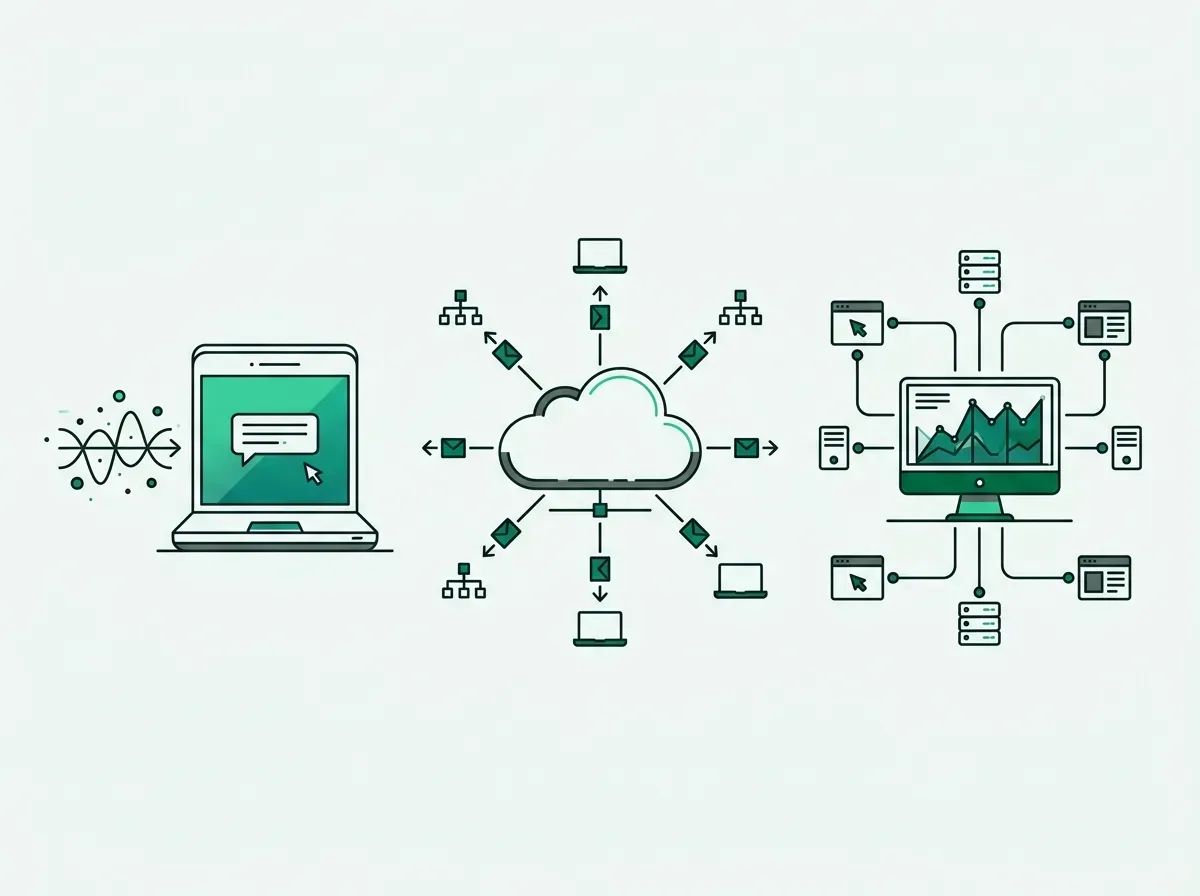
The AI SDR market in 2026 divides into three distinct architectural models: reactive inbound conversion agents, autonomous cloud sequencers, and local browser research applications. Understanding these structural boundaries clarifies where each tool fits within a modern revenue operations stack.
Inbound AI SDRs monitor digital storefronts to capture active buyers. These tools identify incoming web traffic via reverse-IP lookups, converse with visitors through live chat interfaces, and book meetings into account executive calendars. Their scope is strictly inbound; they do not discover net-new accounts or monitor external discussions across third-party networks.
Autonomous cloud senders bundle centralized contact databases, automated copy generators, and secondary mailbox networks into single subscription platforms. While convenient, these platforms rely on cached data lakes that introduce deliverability risks if contact verification fails. By contrast, local browser agents run on the user's desktop, using active browser sessions to inspect live web sources directly, providing verifiable URLs for every data point without charging per-record data credits.
Detailed Teardown of Leading AI SDR Tools
The nine platforms below represent the primary approaches to automated outbound and account research. We evaluate each on operational mechanics, pricing structures, verified source attribution, and architectural tradeoffs.
1. Drevon
Drevon is a free desktop application for macOS (Apple Silicon and Intel) that executes autonomous research agents inside your local browser sessions. By navigating live web destinations—including LinkedIn, Reddit, GitHub, job boards, and news sites—using your authenticated accounts, Drevon extracts explicit buying signals with exact source URLs attached to every factual claim.
Drevon runs locally on your workstation, eliminating per-record credit costs, data vendor contracts, and monthly usage caps. The application drives the AI subscription you already maintain, such as Claude Code, OpenAI Codex, GitHub Copilot, or Google Gemini. For teams tracking technical discussions, our guide on how we find B2B buying signals on Reddit demonstrates how live browser exploration surfaces buying intent weeks before it reaches static databases.
Researched accounts export to structured CSV and Markdown files on your local drive, ready for immediate import into downstream engagement tools. While Drevon focuses on research rather than mailbox sequencing, it prevents context hallucination by anchoring every record in evidence-based prospecting.
2. Artisan (Ava)
Artisan provides an outbound AI agent named Ava that consolidates contact discovery, email warmup, automated personalization, and reply categorization inside a cloud console. Ava orchestrates multi-touch campaigns across secondary sending mailboxes.
According to the official Artisan pricing page (checked August 2026), contracts are billed annually based on lead volume tiers. Published procurement reviews in the 11x comparison guide, the GetFuzzy Artisan pricing analysis, and the Prospeo pricing review indicate that entry tiers start around $9,000 to $26,000 annually, with median realized contracts landing near $26,250 per year. Artisan handles domain setup cleanly, though its 300M+ contact pool relies on static records that can lack deep context on emerging technical communities.
3. 11x (Alice & Julian)
11x builds autonomous digital workers, including Alice for outbound email prospecting and Julian for inbound conversational triage. The system manages prospect queues, handles multi-turn email replies, and syncs meeting updates into Salesforce or HubSpot.
Official pricing published on the 11x website (checked August 2026) lists the Alice Growth tier at $3,750 per month on an annual contract ($45,000 per year), which includes up to 2,000 researched prospects per month and managed mailbox infrastructure. Independent teardowns such as the SyncGTM 11x review, the SeraLeads 11x pricing overview, and competitor analysis on Skyp.ai note that Pro and Enterprise configurations scale further with custom volume. 11x provides strong autonomous reply workflows, but outbound lists depend on centralized enrichment lakes rather than live browser inspection.
4. AiSDR
AiSDR automates objection handling, inbound lead qualification, and multi-step email campaigns. It uses structured routing logic to qualify inbound prospects and draft contextual responses to schedule meetings.
According to comparative industry research in the Jobix AI SDR pricing comparison, AiSDR maintains public self-serve pricing starting at $250 per month for Solo plans (200 researched leads) and $900 per month for Explore plans (800 leads, or $720 per month billed annually). AiSDR handles standard inbound objection flows well, though operators must supply external enrichment inputs for complex account intelligence.
5. Regie.ai
Regie.ai provides agentic outbound infrastructure focused on enterprise compliance, content guardrails, and deep synchronization with Outreach, Salesloft, and HubSpot. Rather than replacing human reps, it functions as an agentic copilot that helps sales teams build signal-based sequences.
Pricing starts at $180 to $499 per seat per month (checked August 2026), typically requiring team minimums that place annual commitments between $10,000 and $25,000. Regie.ai enforces brand governance and content approvals effectively, though deployment across complex enterprise environments requires dedicated onboarding.
6. Reply.io (Jason AI)
Jason AI operates as an autonomous conversational assistant within Reply.io's multichannel sequencing platform. It handles sequence generation, basic social touchpoints, and prospect response triage.
Reply.io offers Jason AI as a modular add-on starting at $500 per month for 1,000 active AI contacts, in addition to core platform seat fees ($49 to $99 per user per month). Jason AI integrates smoothly with existing delivery pipelines, though exploratory discovery on niche accounts requires third-party list enrichment.
7. Nex
Nex builds internal knowledge graphs across your CRM records, team Slack channels, and recorded sales calls to inform outbound drafting. By referencing historical deal context, Nex drafts messaging aligned with past customer conversations.
Nex provides strong internal context synthesis for product messaging under custom enterprise contracts. However, its external prospect discovery relies on standard web indexes rather than live, authenticated browser sessions.
8. gtm.ai
gtm.ai acts as ZoomInfo's agent-native interface, offering a Model Context Protocol (MCP) server and API layer over ZoomInfo's commercial data assets. It enables developers to query enterprise contact databases via natural language prompts.
gtm.ai provides extensive coverage for established enterprise accounts. However, querying static records consumes vendor credits and remains vulnerable to standard database decay. Teams looking to understand how credit limits restrict exploratory research can review our breakdown of how credit-based pricing models penalize discovery.
9. Qualified (Piper)
Piper is an inbound conversational AI agent (acquired by Salesforce) that identifies high-intent accounts visiting your website, engages visitors via live chat, and books discovery calls in real time.
Qualified deploys under custom annual enterprise contracts, with procurement benchmarks tracking typical commitments between $40,000 and $68,000 per year (checked August 2026). Piper accelerates inbound conversion for web traffic, but its architecture is strictly reactive and does not execute outbound research.
Comparison Matrix: Architecture, Sourcing, and Pricing
Selecting an outbound software platform requires balancing execution environments, data freshness, source verification, and licensing terms. The table below details the operational profiles of the nine evaluated platforms.
| Platform | Execution Model | Primary Data Source | Source URLs Provided | Pricing Model (Checked August 2026) |
|---|---|---|---|---|
| Drevon | Local Desktop (macOS) | Live Browser (LinkedIn, Reddit, GitHub) | Yes (Every Claim) | Free (Bring Your Own AI Subscription) |
| Artisan (Ava) | Cloud SaaS | Proprietary 300M+ Contact Pool | No | Annual contract (~$9k–$45k+/yr; median $26,250/yr) |
| 11x (Alice) | Cloud SaaS | Proprietary Enrichment Network | No | Published $3,750/mo ($45k/yr) Growth list price |
| AiSDR | Cloud SaaS | Integrated B2B Database | No | $250/mo (Solo) to $900/mo (Explore) |
| Regie.ai | Cloud SaaS | Contact Database + CRM | No | $180–$499/seat/mo (Team seat minimums apply) |
| Reply.io (Jason AI) | Cloud SaaS | Reply.io B2B Network | No | $500/mo add-on + $49–$99/seat platform fees |
| Nex | Cloud SaaS | Internal Knowledge Graph + Web | Partial | Quote-only custom enterprise pricing |
| gtm.ai | Hosted MCP / API | ZoomInfo Commercial Database | No | ZoomInfo enterprise contract + usage credits |
| Qualified (Piper) | Cloud SaaS | Website Reverse-IP & Salesforce CRM | No | Enterprise contract (~$40k–$68k/yr benchmark) |
Understanding data acquisition mechanics is vital when selecting outbound tools. Reviewing waterfall enrichment vs. browser intelligence clarifies why live browser extraction captures fresh signals that static contact providers miss.
How to Choose Between an Autonomous AI SDR and Intent Research
Choosing the right architecture depends on whether your pipeline bottleneck is sequence execution volume or research precision. Decoupling live account research from delivery infrastructure allows teams to protect domain deliverability while eliminating expensive database contracts.
Organizations managing substantial inbound web traffic see clear returns from inbound agents like Qualified Piper. Enterprise teams requiring supervised rep drafting benefit from copilot platforms like Regie.ai. Teams deploying autonomous senders like Artisan or 11x must budget for dedicated mailbox infrastructure, domain warmup tools, and deliverability monitoring.
For growth engineers and technical sales teams, separating research from delivery yields better results. Using Drevon to verify target accounts against primary sources prevents domain burn. To see how engineering teams structure this workflow, explore our guides on the job-based GTM stack, what is a GTM engineer, and hands-on GTM tool comparisons.
Before launching outreach, teams must separate verifiable intent from background activity by reviewing what proof of intent really means, understanding signal vs. noise, and monitoring nine buying signals you can't get from a contact database. For teams evaluating data platforms, comparing Clay vs. Drevon and reviewing the integration tax clarifies ongoing tooling expenses.
Frequently Asked Questions
What is the difference between an AI SDR and an AI prospect research tool?
An AI SDR focuses on automated sequence delivery, secondary inbox rotation, and programmatic reply management through cloud software. An AI prospect research tool like Drevon focuses specifically on navigating live web platforms to surface verified account signals, hiring updates, and technical proof of intent before outreach begins.
Why do autonomous AI SDR tools cause high email bounce rates?
Most autonomous AI SDR platforms query static third-party contact databases that decay significantly each year. When automated sequences send emails to outdated records without prior verification, bounce rates can easily exceed 2%, risking domain throttling under modern Google and Yahoo mailbox enforcement rules.
How much does an enterprise AI SDR tool cost in 2026?
Enterprise AI SDR platforms generally require annual commitments. Official pricing for 11x Alice starts at $3,750 per month ($45,000 annually), while Artisan Ava procurement contracts range from $9,000 to $45,000+ per year (median $26,250). Modular platforms like AiSDR provide self-serve tiers starting at $250 to $900 per month.
Can Drevon export prospect data directly into sales engagement tools?
Yes. Drevon exports researched prospects directly to structured CSV and Markdown files containing validated account attributes, observed trigger summaries, and clickable primary source URLs. These structured exports import directly into any standard email sequencing tool, CRM platform, or enrichment pipeline.
Build prospect lists grounded in primary source evidence. Download Drevon for macOS for free and run live account research using your existing AI credentials in minutes.