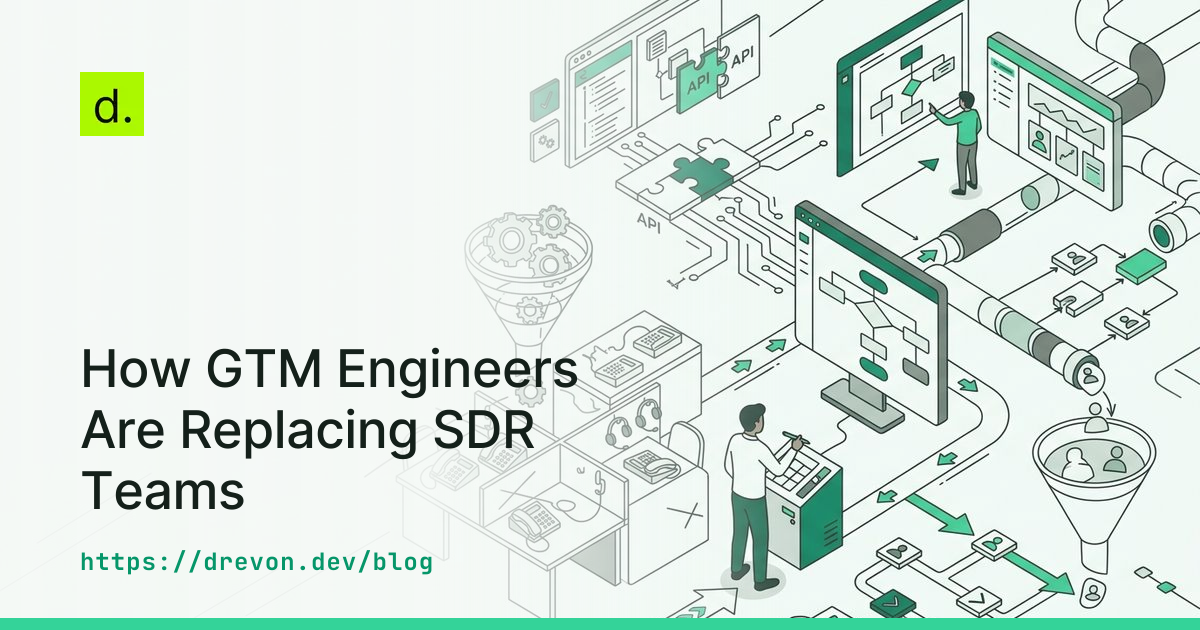
How GTM Engineers Are Replacing SDR Teams
How GTM Engineers Are Replacing SDR Teams
TL;DRA single GTM engineer running local browser agents replaces the pipeline output of three to five SDRs while reducing top-of-funnel labor costs by 50% to 70%.Static contact databases decay at 22.5% to 30% annually, while primary-source intent mining on live platforms yields 15% to 25% reply rates.Deterministic filters built on source code, job postings, and community discussions eliminate subjective list scoring and arbitrary enrichment credits.Running agent workflows locally in your desktop browser cuts account restriction rates from 31% down to 8% compared to cloud scrapers.
According to The Bridge Group, the median fully loaded cost of an enterprise sales development representative sits at $134,000 to $142,500 per year, while average quota attainment across B2B software teams has dropped to between 41% and 57%. At Drevon, we designed our free macOS prospect research app around a structural reality: outbound pipeline generation is an engineering problem, not a headcount problem. When technical revenue teams replace manual list building with deterministic code and autonomous browser agents, they eliminate the hiring-and-ramp treadmill while improving lead quality.
The Unit Economics of GTM Engineering vs Manual SDR Teams
A traditional SDR team scales payroll linearly while pipeline conversion rates compress under database decay. In contrast, what a GTM engineer builds is reusable data infrastructure that extracts live signals from primary web surfaces, delivering higher pipeline volume at a fraction of the cost.
Research from Pavilion shows that 73% of companies underestimate the true cost of an in-house SDR by 40% to 80%. When accounting for taxes, benefits, management overhead, and $8,000 to $15,000 in annual per-seat software licenses, an SDR team of four reps and one manager costs $650,000 to $850,000 annually. That team turns over every 14 to 16 months, burning three to four months of non-productive ramp time per cycle.
A single senior GTM engineer commanding $160,000 to $200,000 in compensation operates an automated pipeline engine that generates the top-of-funnel output of five manual reps. Data documented in HubSpot’s database decay research confirms that static contact data decays at roughly 22.5% per year, and Gartner reports decay rates reaching up to 70.3% annually in volatile software sectors. That compounding inaccuracy explains why we explored why B2B data decays by over 30% annually: static databases sell cached records that are already obsolete by the time reps send an email.
| Operating Metric | Traditional SDR Motion (4 Reps + 1 Manager) | GTM Engineering Model (1 Engineer + Agents) |
|---|---|---|
| Annual Fully Loaded Cost | $650,000 – $850,000+ | $180,000 – $240,000 |
| Weekly Research Capacity | 160 – 240 target accounts total | 1,000+ accounts with verified signals |
| Average Response Rate | 1.0% – 3.4% (cold database export) | 15.0% – 25.0% (signal-triggered) |
| Lead-to-Meeting Conversion | 1.2% average | 8.7% average |
| Asset Value Over Time | Depreciating (rep turnover, lost context) | Compounding (reusable code, local datasets) |

1. Live Intent Mining Across Primary Communities
Primary communities like Reddit, specialized developer forums, and LinkedIn discussions contain explicit buying questions weeks before third-party data aggregators tag an account with intent. GTM engineers monitor these surfaces directly rather than purchasing stale predictive scores from data vendors.
Traditional intent vendors aggregate aggregated bidstream data and third-party content consumption into topic scores. This data lacks conversational context. When a technical buyer asks for vendor recommendations in a community thread, that post represents active evaluation. Our team documented how to capture these conversations in how we find B2B buying signals on Reddit, demonstrating how GTM engineers extract explicit product pain points from forum discussions.
By connecting community mentions to corporate domains via identity-resolution workflows described in resolving anonymous intent on Reddit, GTM engineers hand their account executives warm prospect accounts. Outreach anchored in an unprompted public question converts at 8% to 20%+, compared to 1.0% to 2.0% for cold database lists.
2. Deterministic ICP Scoring from Source Code and Job Postings
Manual SDR qualification relies on subjective interpretations of buyer personas and arbitrary company size filters. GTM engineers replace subjective rubrics with deterministic code that inspects frontend scripts, API documentation, hiring postings, and public changelogs.
Instead of assigning an arbitrary 1-100 numerical score, an automated pipeline applies binary qualification rules. A script inspects target company domains for specific SDK installations, client-side libraries, or tracking pixels. Simultaneously, browser agents parse active job listings to verify whether a team is recruiting engineers with experience in specific database engines or cloud infrastructure. We outlined this exact setup in ICP scoring without a data vendor.
This deterministic inspection ensures that zero SDR hours are spent reviewing accounts that fail basic technical compatibility criteria. The resulting qualified list feeds directly into automated sequencing or AE routing with verified criteria attached to every record.

3. Automated Pre-Call Research and Account Briefs
Junior sales reps spend 20 to 30 minutes per prospect digging through LinkedIn posts, press releases, and SEC filings to write pre-call briefing documents. GTM engineers program browser agents to compile structured dossiers directly into local Markdown or CSV files in under 10 minutes.
An automated briefing workflow navigates to the prospect company’s newsroom, recent executive interview transcripts, and changelog pages. The agent extracts quotes regarding strategic priorities, recent vendor migrations, and team expansions. This research methodology, detailed in automating pre-call briefs with AI agents, puts an account dossier in front of an account executive before the discovery call starts.
Because the agent operates locally, it saves raw outputs directly into project folders, integrating into internal CRM fields or AE Slack channels via webhook handlers.
4. Evidence-Backed Account Trigger Monitoring
Tracking leadership transitions and engineering team expansions via static third-party contact databases introduces weeks of latency. GTM engineers monitor live professional networks directly to catch champion migrations on day one.
According to multi-year B2B outbound benchmarks from Forma Nôrden and SpurIQ, outreach triggered by an executive job change achieves a 6% to 10% reply rate and a 35% to 50% meeting-to-reply conversion rate. When reps reach out based on static contact lists without an intent trigger, meeting-to-reply conversion drops to 15% to 25%. GTM engineers extract these patterns by monitoring the signals described in our guide to nine LinkedIn signals that predict buying intent.
Crucially, every trigger item generated by an automated GTM pipeline carries an immutable source URL. Our team laid out the technical requirement for this standard in evidence-based prospecting: why every lead needs a source URL. If an agent asserts that a VP of Engineering changed companies or posted a specific hiring need, it provides the direct hyperlink verifying the claim.
5. Local-First Orchestration Without Database Subscriptions
Enterprise data platforms bill on restrictive monthly credit tiers that penalize exploratory research and drive up acquisition costs. GTM engineers bypass per-credit markups by running local browser agents connected directly to existing LLM subscriptions.
Platforms like Clay (Starter plans beginning at $149/month, checked August 2026) and Apollo.io rely on credit consumption models for data waterfalls. As we analyzed in credit-based pricing models penalize discovery and how per-credit pricing degrades your lead lists, credit constraints force reps to truncate search queries and purchase unverified bulk records to conserve budget.
Local-first tools run inside the user's authentic desktop session. Datacenter proxies and headless cloud scrapers trigger anti-bot protections; industry data shows cloud-based automation tools suffer a 31% account restriction rate on protected professional networks, whereas local browser sessions show an 8% restriction rate. Local execution also stores prospect tables in local SQLite databases, resolving enterprise compliance concerns as detailed in our guide on GDPR-compliant lead research.
| Platform / Tool | Execution Model | Data Source | Pricing Structure | Primary Strength |
|---|---|---|---|---|
| Drevon | Local Desktop (macOS) | Live Browser Sessions & Primary Web Sources | Free (BYO AI Subscription) | Evidence-backed discovery with verified source URLs and zero cloud proxy blocks. |
| Clay | Cloud SaaS | Third-Party API Aggregators & Waterfall Enrichment | Per-Credit Subscription ($149+/mo) | Spreadsheet UI for chaining multiple third-party API data vendors together. |
| Apollo.io | Cloud SaaS | Proprietary Static Contact Database | Per-Seat + Per-Credit Plans | Large-scale contact email lookup and integrated cold email sequencer. |
| gtm.ai | Hosted MCP Server / API | ZoomInfo Licensed Database | Enterprise Contract + Data Credits | Direct programmatic access to ZoomInfo enterprise records for coding agents. |
| Nex | Cloud SaaS | Internal CRM, Slack, & Email Knowledge Graph | Enterprise SaaS Contract | Autonomous internal account coordination and CRM data management. |

When to Keep SDRs and Where Full Automation Falls Short
While GTM engineers outperform manual SDRs at intent detection, data enrichment, and list generation, specific sales motions still require human reps. Cold phone qualification, live event prospecting, and high-touch enterprise account relationship building remain effective human-led channels.
Furthermore, automated pipelines experience technical failure modes. Target websites alter their DOM structures, community anti-scraping rules evolve, and AI prompts experience context drift over large datasets. A resilient revenue architecture pairs a technical GTM engineer managing autonomous workflows with experienced account executives handling discovery calls. Revenue leaders seeking implementation steps can consult our breakdowns on 7 GTM workflows now run by AI agents and 12 GTM workflows to automate with engineering.
Frequently Asked Questions
What is the difference between a GTM engineer and an SDR?
An SDR manually searches databases, qualifies prospects by hand, and writes individual outreach emails. A GTM engineer writes software, configures browser agents, and builds data pipelines that automate prospect discovery, qualification, and dossier generation at scale.
Can one GTM engineer realistically replace a five-person SDR team?
Yes. By automating intent mining across Reddit, LinkedIn, and job boards, one GTM engineer generates more verified, signal-qualified leads per week than five SDRs manually assembling static contact lists.
Why are cold email reply rates declining for static database lists?
Cold email reply rates have dropped to 3.43% because static contact lists lack timing context and suffer from 22.5% to 30% annual data decay. Signal-triggered outreach achieves 15% to 25% reply rates by contacting accounts showing active, verifiable buying behavior.
How do local browser agents prevent account restrictions?
Local browser agents execute within your authenticated, existing desktop browser profile rather than headless cloud datacenters. This keeps account restriction rates around 8%, compared to 31% for cloud-based scraping tools operating across shared IPs.
If you are ready to transition from manual list building to engineering-led prospect research, download Drevon for macOS today at drevon.dev/download. It runs locally in your browser using the AI subscription you already pay for, delivering verified leads with complete source evidence.