Intent Data in 2026: What It Measures and What It Misses — 390/mo
Intent Data in 2026: What It Measures and What It Misses
- Third-party intent data measures account-level content consumption surges across publisher networks, but fails to identify individual decision-makers or buying stages.
- Hybrid work, VPNs, and browser privacy changes have reduced standalone IP-to-company identification accuracy to between 10% and 30% for distributed teams.
- Over 70% of the B2B buying journey occurs in un-instrumented peer channels like Reddit, niche communities, and private technical forums rather than ad-network article pages.
- Traditional intent platforms require $25,000 to $60,000 annual commitments while providing probabilistic domain scores without verifiable source URLs.
- Modern GTM workflows replace opaque topic surges with deterministic, primary-source buying signals verified directly in the browser.
Third-party intent data tracks content consumption across digital networks to score macro interest, but it fails to identify individual buyers or deliver verifiable evidence. Teams spend tens of thousands of dollars on annual vendor contracts only to hand sales development representatives account lists marked with vague topic surges like "Cloud Security: High Intent" without a single name, role, or source link. At Drevon, we built our free macOS research agent to replace probabilistic data modeling with deterministic evidence gathered directly from live primary sources.
What Third-Party Intent Data Actually Measures
Third-party intent data measures macro consumption spikes across digital publisher networks by matching visiting IP addresses to corporate domains and comparing reading activity against a historical baseline. When multiple devices from a company read articles tagged with specific category keywords over several weeks, the intent vendor flags that account as surging.
To understand the utility of these feeds, growth teams must examine the underlying mechanics of how intent vendors gather and process activity across the web. Most legacy intent vendors rely on two primary collection models: cooperative content syndication networks and programmatic ad-exchange bidstreams.
In a publisher cooperative (such as Bombora), thousands of participating business-to-business websites embed tracking tags. When an anonymous visitor loads a piece of technical content, the publisher tag records the page topic, scroll depth, dwell time, and the visitor's public IP address. The platform compares this consumption against a baseline (often 3 to 12 weeks of historical activity) to determine if an organization is reading significantly more content on that topic than usual.
Bidstream intent vendors, by contrast, listen passively to real-time bidding (RTB) auctions across ad exchanges. When an ad auction runs, the bid request broadcasts the user IP address and the hosting page URL. The vendor logs the URL keywords and associates the transaction with a corporate domain via reverse-DNS lookups. While this provides broad signal volume, it captures fleeting ad impressions rather than sustained engagement.
Both models excel at delivering high-level category awareness. They reveal when a large enterprise might be exploring a broad technological shift, helping marketing teams trigger top-of-funnel account-based advertising campaigns. They do not, however, reveal who is researching or why.

The Four Structural Blind Spots of Traditional Intent Feeds
Traditional intent feeds suffer from four structural blind spots: account-level opacity that conceals the actual buyer, temporal reporting lags of two to four weeks, severe IP resolution failures caused by hybrid work environments, and a total absence of verifiable source URLs for SDR outreach.
While intent platforms promise early pipeline visibility, their structural architecture introduces severe friction into real outbound prospecting workflows.
1. Account-Level Opacity
An intent surge informs your team that an organization has crossed an engagement threshold, but it cannot differentiate between an entry-level employee researching a homework assignment and a Vice President evaluating vendor shortlists. Because the signal attaches strictly to the domain, revenue teams must purchase secondary data credits to guess which personas to contact. This distinction between raw data volume and verified buyer intent is why modern teams study signal vs noise in buying intent before launching outbound campaigns.
2. Temporal Lag and Ingestion Latency
Intent scores are not real-time feeds. Raw telemetry passes through ingestion pipelines, deduplication filters, domain-mapping algorithms, and weekly scoring updates before landing in your CRM. By the time an account appears as surging in a dashboard, the internal buying committee has often already narrowed down their vendor shortlist. According to research from 6sense, 60% of the entire buying journey is completed independently before buyers reach out to vendors, and 80% of winning deals are awarded to vendors favored on day one.
3. Remote Work and IP Resolution Breakdown
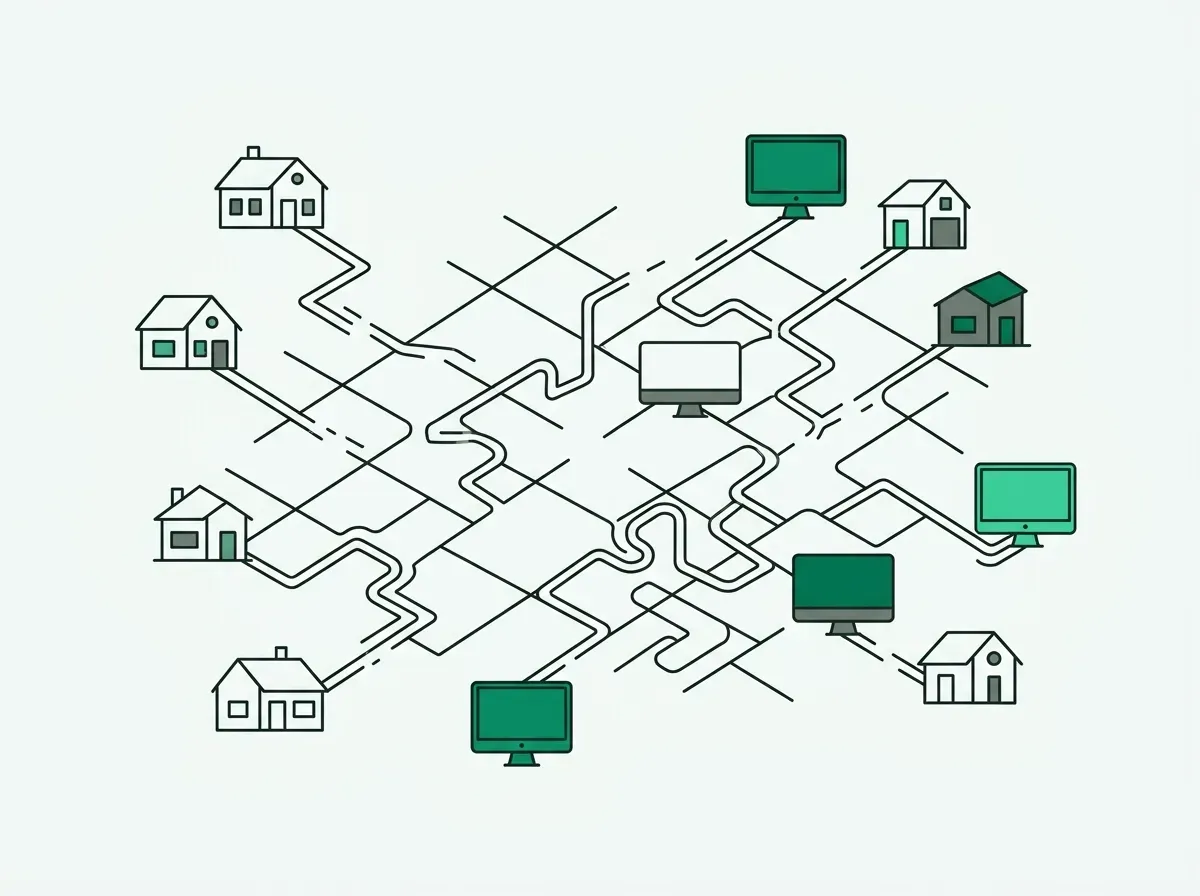
The post-pandemic shift to distributed work fundamentally undermined reverse-IP lookups. When knowledge workers access information from home broadband connections, their traffic resolves to consumer Internet Service Providers (like Comcast or Charter) rather than a corporate network.
Documented benchmark studies published by Leadfeeder on visitor identification show that realistic company-level de-anonymization rates drop to between 10% and 40% under hybrid conditions. Additional findings from the Upvert de-anonymization benchmark report indicate that standalone IP lookups routinely fail to resolve remote residential networks. As detailed in technical analyses of company identification mechanics, mid-market and SMB match rates degrade sharply because dynamic IP pools lack static registration records.
This tracking infrastructure faces further erosion from browser privacy layers. Features like Apple iCloud Private Relay routing egress Safari traffic through dual-hop proxies, preventing website scripts from capturing originating client IPs entirely. Meanwhile, regulatory scrutiny has tightened around programmatic auctions. The FTC issued explicit warnings regarding real-time bidding data aggregation in FTC v. Mobilewalla and reaffirmed compliance mandates under PADFAA data broker regulations, restricting passive tracking feeds.
4. Absence of Verifiable Provenance
A score in a spreadsheet (such as "Intent Score: 88/100") provides no conversational context. Sales representatives cannot write a compelling email saying, "Our database noticed your IP address looked at cloud computing articles." Without an exact source URL, quote, or specific problem statement, outreach remains generic. Understanding what proof of intent really means requires moving away from opaque scores toward verifiable records.
Comparing Intent Sources: Aggregate Feeds vs. Primary-Source Signals
Aggregate intent feeds provide probabilistic company-level scores across licensed publisher networks under fixed annual software contracts. Primary-source signals capture deterministic, individual-level buying criteria directly from open public networks, community forums, job boards, and code repositories, providing transparent source links without intermediary data fees.
To evaluate where your prospecting budget delivers the highest conversion velocity, compare the mechanics, coverage, and financial commitments of both models across critical operational dimensions.
The table below summarizes the operational differences between legacy intent databases and direct primary-source intelligence.
| Dimension | Third-Party Intent Feeds (Bombora, 6sense, ZoomInfo) | Primary-Source Browser Signals (Drevon, Open Web) |
|---|---|---|
| Data Resolution | Probabilistic domain level (matches an IP to an enterprise CIDR block). | Deterministic individual level (specific practitioners and decision-makers). |
| Collection Mechanism | Publisher co-op tracking pixels or ad-exchange bidstream scraping. | Live browser agents reading public forums, job boards, and communities. |
| Source Verification | Opaque score (no accessible source URL or timestamped text). | 100% verifiable (every output row includes an active source URL). |
| Buying Stage Captured | Early problem awareness and broad category browsing. | Active problem discussion, vendor evaluation, and tooling migration. |
| Hybrid Match Fidelity | 10% to 30% de-anonymization on remote/residential networks. | Unchanged by remote work; reads public web content and member sessions. |
| Annual Stack Cost | $25,000 to $60,000+ per year in fixed software commitments. | Free desktop app; executes locally using existing AI subscriptions. |
| Export Restrictions | Credit-gated consumption, per-seat tiers, and export caps. | Direct local export to CSV and Markdown with zero credit penalties. |
Enterprise intent tools charge substantial fees to access their proprietary topic networks. Procurement data indicates that Bombora Company Surge packages run between $25,000 and $30,000 annually for baseline topic monitoring, while 6sense contracts average $50,000 to $60,000 per year. Adding intent feeds to ZoomInfo SalesOS raises contracts to $25,000 to $40,000 annually, with additional per-export credit charges. These high software fees force teams to pay before validating data utility, which explains why credit-based pricing models penalize discovery.
High-Yield Primary Buying Signals Missed by Static Databases
Primary buying signals exist in open, un-instrumented technical channels where buyers discuss explicit operational challenges in detail. These high-yield signals include technical community problem statements, specific hiring job descriptions, open-source repository modifications, and documented leadership movements across target accounts.
Static publisher cooperatives miss these channels because technical discussions occur on un-gated platforms that do not participate in commercial tracking networks.

1. Community Problem Statements and Migration Queries
According to research by Reddit and SurveyMonkey, 83% of B2B decision-makers complete their research independently via peer communities and search before speaking with sales. Furthermore, 23% of B2B decision-makers and 32% of enterprise software buyers explicitly consult Reddit to evaluate unfiltered vendor reviews, hidden pricing tiers, and migration trade-offs.
When an engineering leader asks a subreddit for recommendations on replacing an unreliable database vendor, that post represents immediate, active buying intent. An ad-network tracker records nothing because the discussion occurs on an un-instrumented platform. Growth teams using B2B buying signals on Reddit find specific pain points weeks before an account triggers an intent surge in a CRM.
2. Hiring Requirements and Technology Stack Expansions
A job posting for a "Senior GTM Engineer with experience implementing Snowflake and Reverse ETL" reveals active budget, planned infrastructure shifts, and project scope. Static contact databases categorize this company simply by employee headcount and industry code. Identifying real-time hiring posts gives reps an immediate reason for outreach that connects directly to company initiatives, as detailed in our guide to buying signals you cannot get from a contact database.
3. Practitioner Champion Tracking
When an active user or internal advocate moves to a new company, their arrival creates an immediate sales opportunity. Monitoring job changes across target accounts allows reps to reach out to buyers who already understand their product value. Combining champion tracking with LinkedIn signals that predict buying intent yields conversion rates far higher than emailing accounts identified via probabilistic domain surges.
How GTM Engineers Operationalize Evidence-Backed Intent
GTM engineers operationalize evidence-backed intent by deploying automated browser agents that scan primary public sources, extract specific quotes and timestamps, verify stakeholder identities, and output structured records with complete source URLs directly into outbound sequences.
Shifting your revenue engine from speculative intent scoring to deterministic research involves three execution steps:
- Define Signal Extraction Prompts: Instead of monitoring generic category topics like "Data Warehouse," configure prompts that identify specific behavioral triggers. For example: "Find SaaS companies hiring a Data Platform Lead that explicitly mention migrating off legacy on-premise infrastructure."
- Enforce Source URL Validation: Make verified URL provenance a strict requirement in your pipeline. Every lead handed to an account executive or SDR sequence must contain a direct link to the primary source (a job board, LinkedIn post, forum question, or press release). This practice forms the core of building a signal-based engine without intent data.
- Run Local Discovery Agents: Rather than paying per-credit fees for cloud enrichment APIs, execute research tasks locally on your own desktop. Local execution protects corporate browsing sessions and runs through your existing AI subscriptions. This workflow is why Drevon runs on your desktop, allowing practitioners to query live platforms without third-party data broker markups.
By connecting primary source discovery directly to your outbound pipeline, GTM engineers eliminate wasted outreach spend, reduce sales cycle lengths, and provide sales development representatives with context that prospects actually respond to.
Frequently Asked Questions About B2B Intent Data
How is third-party intent data collected?
Third-party intent data is primarily collected through publisher cooperatives and ad-exchange bidstreams. In publisher cooperatives, participating websites embed tracking pixels that log visitor IP addresses, content topics, dwell times, and page views. In bidstream models, vendors listen to real-time ad auctions to capture visiting IP addresses and page metadata. Both systems attempt to resolve IP addresses to corporate domains and score topic consumption spikes against historical baseline averages.
Why do intent data providers produce false positives for remote teams?
Intent data providers produce false positives for remote teams because residential Internet Service Providers assign dynamic, consumer-grade IP addresses that do not map to corporate registries. When remote employees browse from home, reverse-IP lookup systems often misattribute their activity to consumer ISPs (like Comcast or Charter), cloud proxy servers, or regional VPN exit nodes, creating inaccurate domain surges and high false-positive rates for distributed organizations.
What is the difference between first-party, second-party, and third-party intent data?
First-party intent data consists of interactions on your own digital properties, such as product documentation views, pricing page visits, and form submissions. Second-party intent data comes from direct partner relationships or review platforms (like G2 or TrustRadius) tracking activity on your specific profile. Third-party intent data aggregates external reading activity across unaffiliated ad networks and publisher consortiums to calculate broad account-level topic interest.
How does signal-based prospecting differ from traditional intent scoring?
Traditional intent scoring assigns an abstract numerical value to an entire company domain based on aggregate network reading behavior without identifying specific individuals or providing context. Signal-based prospecting discovers specific, verifiable actions taken by individual decision-makers—such as active hiring requisitions, executive leadership changes, code repository updates, or public community problem statements—and pairs every record with an auditable source URL.
Stop paying thousands of dollars for opaque domain scores that fail to convert into pipeline. Download Drevon for macOS for free today and start running autonomous browser agents that extract evidence-backed buying signals directly from primary web sources.