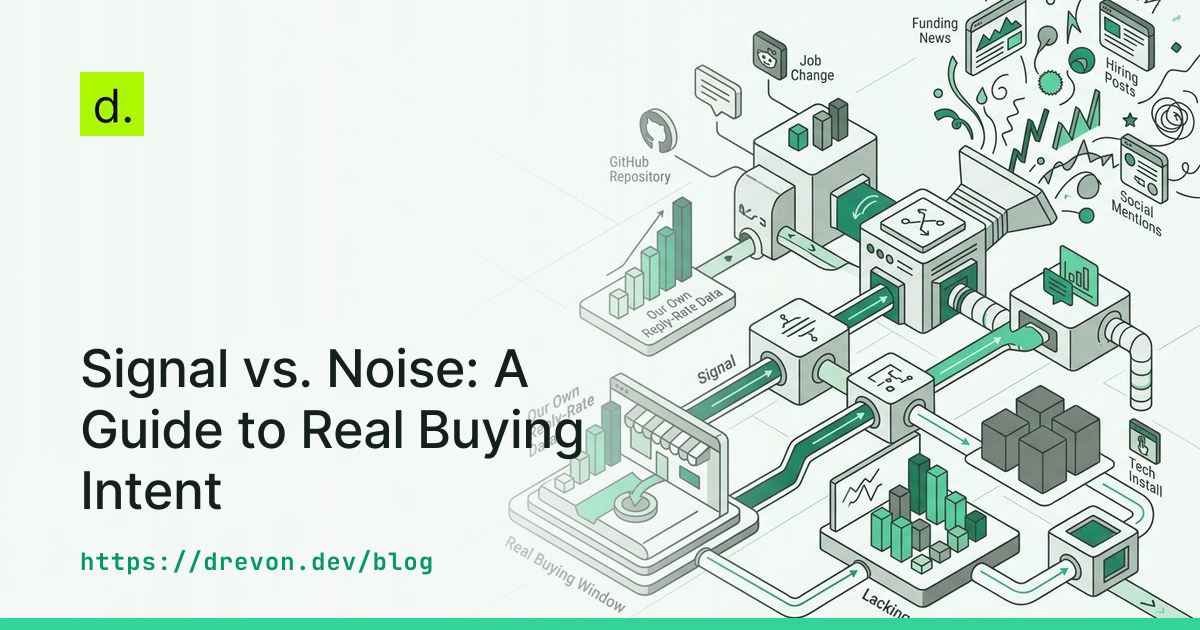
Signal vs. Noise: A Guide to Real Buying Intent
Signal vs. Noise: A Guide to Real Buying Intent
The Problem with Common 'Buying Signals'
Most sales and marketing teams work from the same playbook of buying signals. They track funding announcements, new executive hires, and changes in a company's tech stack. Our internal analysis of over 10,000 outbound triggers shows these common signals have a surprisingly low correlation with actual purchase intent.
These events are public and easy to track, which makes them crowded with competing vendors. They indicate a company is changing, but they do not provide evidence of a specific, urgent problem that you can solve. This post breaks down which signals reliably indicate a buying window and which are vanity metrics.
A Framework for Signal Quality: Problem, Timing, and Authority
A true signal is not just a company update; it is evidence of a problem. We evaluate signals based on three components: an active problem, recent timing, and the involvement of someone with authority to buy.
- Problem: Is there public, explicit evidence of a pain point your product solves?
- Timing: Did the event occur within the last 30 days?
- Authority: Is the person expressing the pain or driving the change in a position to purchase a solution?
Most 'noise' signals only satisfy one of these criteria, usually timing. A funding announcement is recent, but it doesn't describe a specific problem. A high-quality signal hits all three.

High-Correlation Signals: Evidence of Active Pain
The most effective triggers are direct evidence of a problem. These signals are harder to find, but they convert at a much higher rate because they allow for highly relevant outreach.

Reddit and Forum Complaints
When a user publicly describes a problem your product solves, it is the purest form of intent. They are actively seeking a solution. Our data shows that outreach based on specific complaints on platforms like Reddit has a 2.5x higher reply rate than outreach based on generic company news. This is supported by case studies, such as a developer tool SaaS that generated 23 beta signups and converted eight to paid customers by engaging in developer communities.
GitHub Issues and Activity
For technical products, a developer opening an issue, submitting a pull request, or even starring a repository related to a specific problem is a direct signal of need. They are actively working on a technical challenge, and a relevant tool can save them significant time. This is not speculation; it is observing a user's workflow in public.
Specific Hiring Posts
A job post is a public declaration of a strategic priority and budget allocation. However, not all hiring posts are created equal. A generic post for a 'Sales Development Representative' is noise. A specific post for a 'Salesforce Administrator to fix our broken lead routing' is a high-quality signal. It names the problem, the tech stack, and the priority. Data from LinkedIn's Economic Graph confirms this: companies that increase job postings by 30% or more in a quarter are 2.4 times more likely to buy new software in the following quarter. A specific job description is a leading indicator of a future purchase.
Low-Correlation Signals: The Noise Most Teams Chase
These signals are popular because they are easy to find in news feeds and databases. Their accessibility is also their weakness.

Funding Announcements
Funding is a strong signal, but it is also one of the most crowded. While there is no single number for how quickly funded companies buy, B2B sales cycle data shows that deals under $25,000—a common size for a startup's first purchases—close in an average of 30 to 90 days. The window is short, and your outreach arrives alongside dozens of others. The most effective window is the first 24-48 hours, yet many sales teams react too late. By the time most teams respond, the signal is stale and the inbox is full.
New Executive Hires
A new executive's first 90 days are typically spent on discovery, auditing existing systems, and planning. They are under pressure to make an impact, but that pressure usually leads to strategy formation before vendor selection. As research from firms like Gartner suggests, this initial period is for defining priorities, not signing contracts. Contacting a new leader on their first day is often premature.
General Tech Stack Changes
Knowing a company uses Marketo is not a signal. It is a fact, but it lacks intent. The signal appears when there is evidence of friction. For example, knowing a company just uninstalled a competitor and its team is posting on forums about migration challenges is a high-quality signal. The installation of a major platform does not have a standard timeline for when complementary tools are purchased; the trigger is the emergence of a specific need post-install.
Limitations and Where We Lack Data
Our analysis is focused on outbound campaigns for software and developer tools. The correlation strengths of these signals may differ in other industries, such as manufacturing or healthcare.
We also recognize that the impact of a job change is nuanced. A new C-level executive is a different signal than a new manager, but we do not yet have enough data to precisely quantify the reply-rate difference. Finally, our systems primarily track the public web. We have limited data on signals from private communities like Slack or Discord, which likely contain high-intent conversations.
How to Find Real Signals
The most effective go-to-market strategy is to stop tracking generic news and start tracking specific problems. This requires shifting focus from company-level events to user-level pain points.
You can build internal systems to monitor keywords and phrases on public forums, subreddits, and communities where your ideal customers seek help. This allows you to find evidence of active pain and engage with relevance and credibility.
We built Drevon to automate this process. You can give an AI assistant a simple instruction, like "find me developers complaining about CI/CD pipeline failures on Reddit in the last 30 days," and get a list of high-intent leads in minutes.