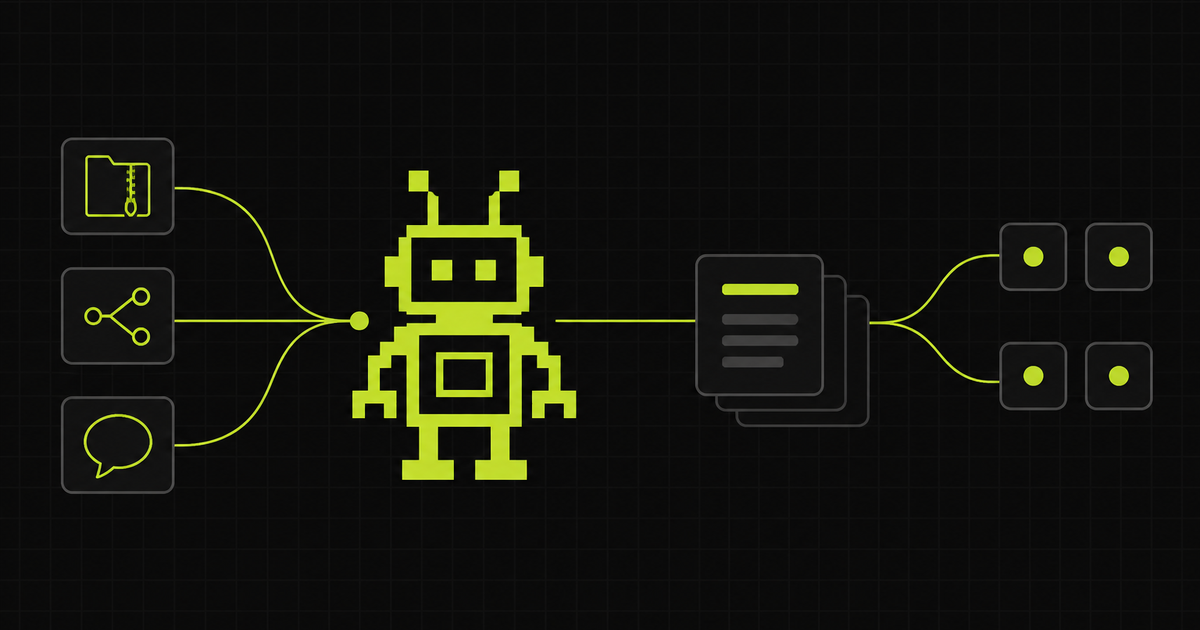
Drevon 1.3.0: bring in any skill, and make your own
A skill is the difference between an agent that can research a company and an agent that researches a company the way you would. It is the checklist, the sources you trust, the format you want back.
Until now, getting one into Drevon meant a zip file or pasting a full npx command, one at a time. And the skills you had already earned — the ones living inside a conversation where you corrected the agent four times until it got it right — had nowhere to go at all.
Drevon 1.3.0 fixes both ends of that.
Drop in a .skill file
Claude exports skills as .skill files. Drag one into Add a Skill and it installs.
If the file holds several skills, all of them install, and each one succeeds or fails on its own — one broken skill in an archive of five no longer costs you the other four. Plain .zip files work identically, because a .skill is a zip; we check the file's actual contents rather than trusting the extension, so a mislabelled file tells you what is wrong instead of failing somewhere deep inside an unzipper.
Or paste a GitHub URL
Point Drevon at a repository — owner/repo, a GitHub link, or a link to one skill folder — and it reads the whole repo in a single request and lists every skill it found, each with the description from its own SKILL.md.
Tick the ones you want. On a large collection, type into the filter and hit Select matching to take everything that matches at once.
Skills the installer genuinely cannot reach are still shown, greyed out, with the reason on the row. That matters more than it sounds: a repo can put a skill somewhere the installer will never look, and a list that silently omitted them left you wondering whether the import was broken.
Everything installs into .drevon, .agents and .claude together, so whichever agent you open next already has it. That is true of every route in this release.
Turn a conversation into a skill
Generate Skill from this conversation reads a session you have already had — which tools ran, which errors came back, where you corrected the agent — and writes a skill from it.
Three things changed here.
It can now write more than one file. A skill that needs a reference table or a script gets references/ and scripts/ alongside its SKILL.md, which is what a serious skill usually looks like. Simple skills stay a single file, because splitting a short skill across folders makes it worse.
You can name it like a human. The name field used to rewrite every keystroke into lowercase-with-hyphens, so capitals were impossible and a space turned into a hyphen before you had finished the word. Type "Find Enterprise Sales Partners"; the folder id appears underneath, derived for you.
And What should this skill capture? is genuinely optional now. Leave it blank and the skill is written from the conversation alone.
The three skill types — technique, pattern, reference — now change what you get. A technique comes back as ordered steps with the reason for each one. A pattern comes back as when to apply an approach and when not to. A reference comes back as tables and exact values, written to be looked things up in rather than read start to finish. Each button says which is which.
When it is done you can edit any file in place, install it, or save it as a .skill file to use anywhere else — including handing it to someone who does not use Drevon.
Skills on drevon.dev
Skills we publish now have their own pages on the website, with the instructions, what the skill is good for, and a one-line install command. The same registry feeds the marketplace inside the app, so anything on the site is already in your Skills tab. Nothing to sync.
When generation fails, it now says why
If the underlying CLI was not signed in, skill generation used to fail after two seconds with "Generated output does not contain SKILL.md frontmatter" — a true statement about the CLI's refusal message, and a completely useless account of what had happened.
Failures now report what the CLI actually said, in words you can act on, and point you at the setting that fixes it. Generation also checks the CLI is signed in before it starts, instead of spending three minutes finding out.
Related: generation and automatic chat titling were the only two things in Drevon that did not use the Claude token you set in Settings. Every agent run did. They do now too.
Smaller things
A skill whose display name was not its folder name could never install. "Account Health" produced a command pointing at a folder called Account Health, which does not exist — the folder is account-health. Drevon now carries the folder name through, and older installs keep working untouched.
Install counts are real. A successful install reports back, so the number on a skill's card reflects something instead of sitting at zero forever.
The tabs in the Add a Skill dialog wrapped onto two lines once there were three of them. They fit on one line now.